RBA Cash Rate 2026: What a 0.25% Cut Does to a $750,000 Loan and a Brisbane Median
The RBA cash rate sits at 4.10% in early 2026. Market pricing implies one to three cuts during the calendar year, with the first 25 basis-point cut expected mid-year. The headlines focus on borrower relief; the dollar impact is modest per cut and material only when the cuts compound. The flow-through to property prices is real but smaller and slower than the borrower narrative implies.
This post lays out the actual numbers — what each 25-basis-point cut does to a $750,000 loan, what it adds to suburb medians across Sydney, Melbourne, Brisbane, Perth, and Adelaide, and where the second-order effects matter for investors.
Where The Cash Rate Is And Where It Is Going
The RBA held at 4.10% through most of 2025 and signalled extended caution. Headline inflation back inside the 2-3% target band creates room to cut; sticky services inflation, tight labour market, and elevated household debt make the Board reluctant to cut aggressively.
The 2026 base case across major bank forecasts:
| Forecaster | End-2026 cash rate |
|---|---|
| Westpac | 3.35% |
| CBA | 3.60% |
| NAB | 3.85% |
| ANZ | 3.60% |
| RBA implied (futures pricing) | 3.55% |
Roughly two to three 25-bp cuts across 2026, with the first arriving mid-year. The market is not pricing aggressive easing.
What 25 Basis Points Saves On A $750,000 Loan
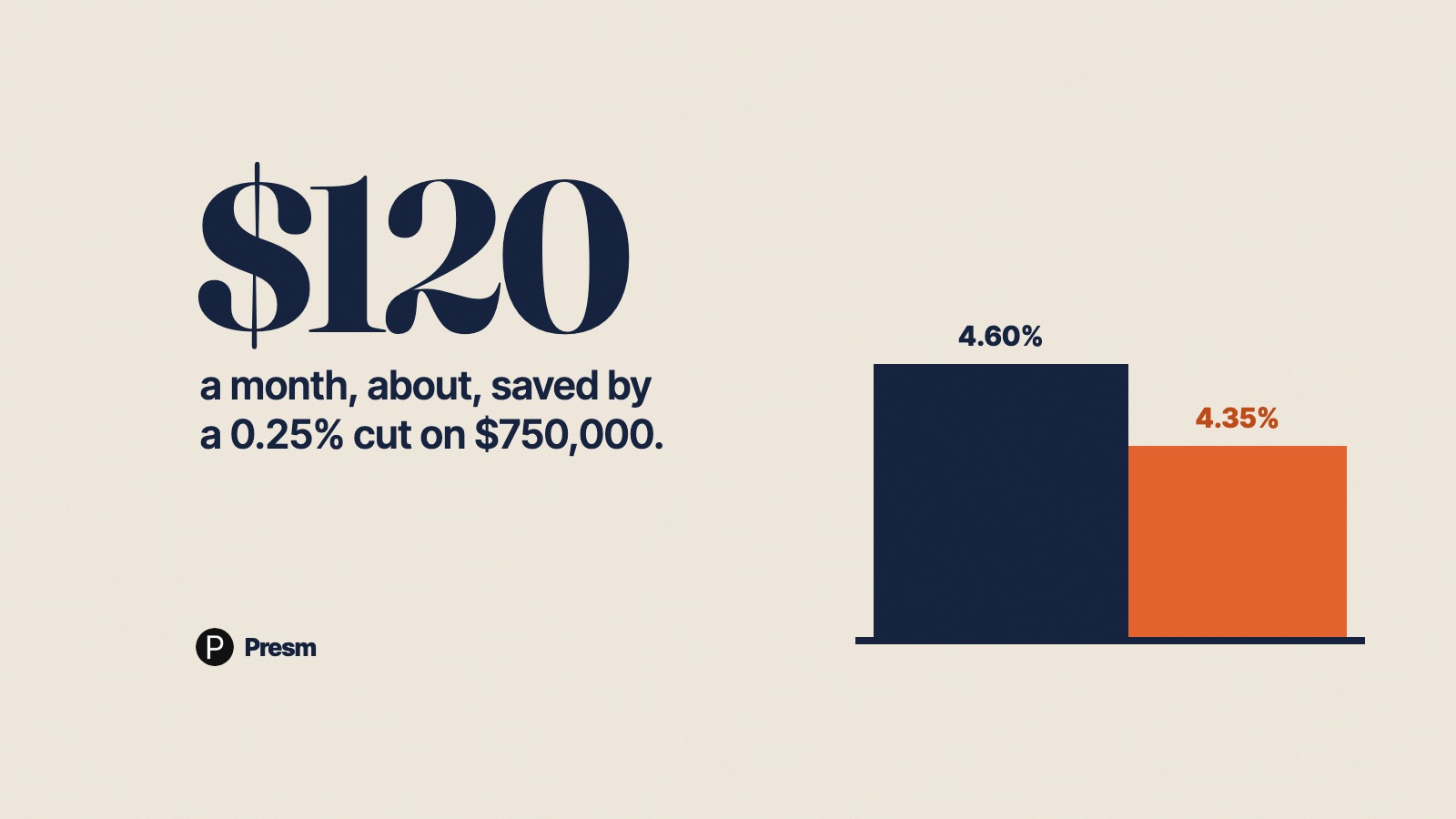
A standard variable owner-occupier loan at 6.05% costs $45,375 per year of interest on a $750,000 IO position. After a 25-bp cut to 5.80%, interest costs $43,500 — a saving of $1,875 per year, or $36 per week.
A 75-bp combined cut (full 2026 expectation) takes the rate to 5.30%. Annual interest saving: $5,625. Weekly: $108.
For investors on IO loans, this is a meaningful improvement to cash flow but does not fundamentally reshape the deal. A property that is $200/week negatively geared at 6.05% is still $90/week negatively geared at 5.30%. The strategy stays the same; the holding cost gets easier.
For owner-occupiers on P&I loans, the same saving partially translates to lower repayments, partially to faster paydown, depending on whether the borrower keeps their repayment fixed.
What 25 Basis Points Does To Property Prices
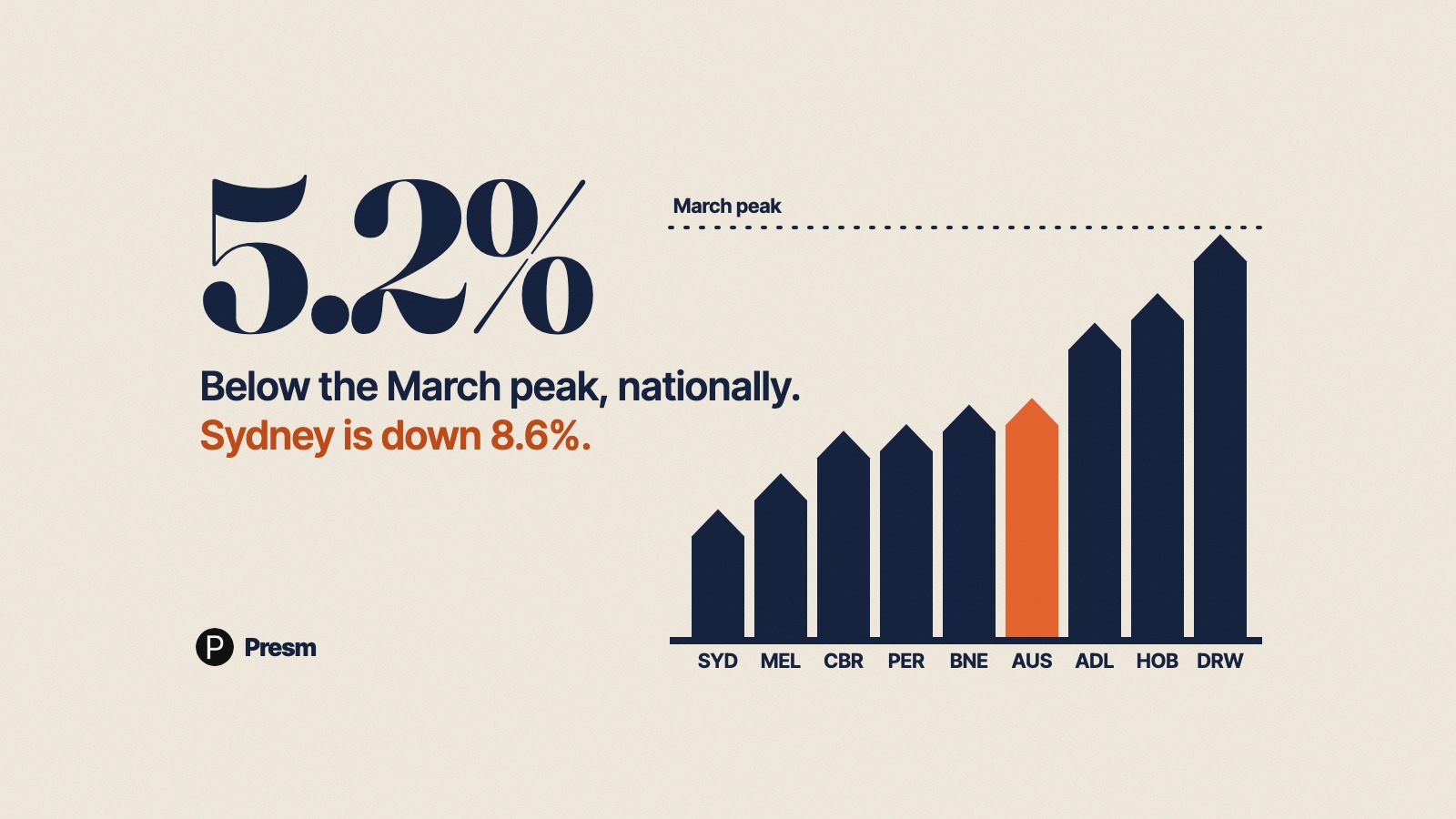
The empirical relationship between cash rate cuts and capital city median prices is messier than the textbook suggests. CoreLogic data over the last 30 years shows roughly a 0.7-1.2% lift in capital city median prices per 25-bp cut, with the response concentrated in the first 6-12 months after cuts begin.
For specific markets:
| Market | Approximate price response per 25-bp cut |
|---|---|
| Sydney (median house $1.42M) | +1.2-1.5% |
| Melbourne (median house $930K) | +1.0-1.3% |
| Brisbane (median house $850K) | +0.7-1.0% |
| Perth (median house $750K) | +0.4-0.7% |
| Adelaide (median house $780K) | +0.6-0.9% |
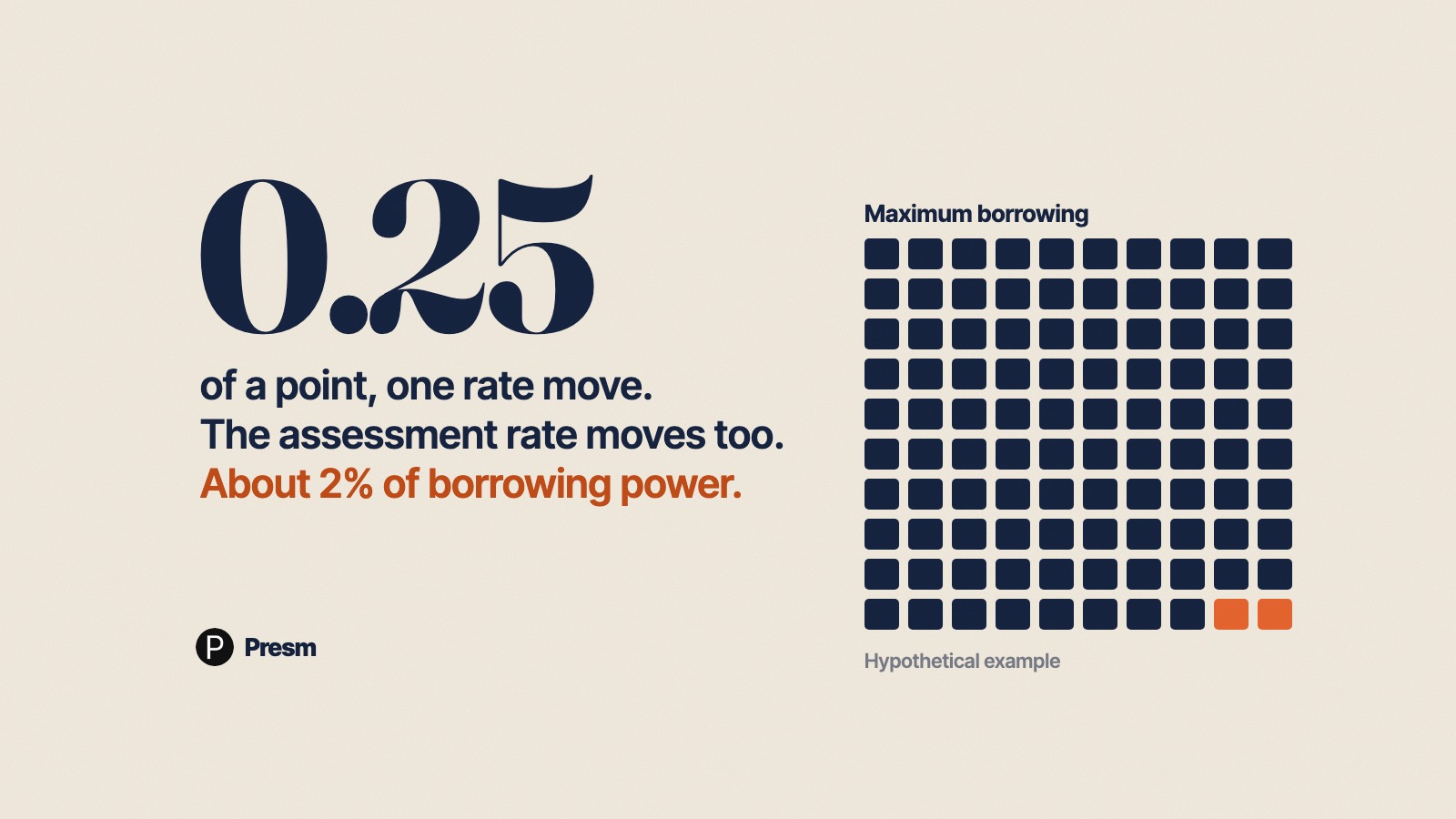
The bigger response comes from the second-order effect: serviceability expansion. APRA's buffer is 3% above the product rate. A cut to 5.30% means lender assessment at 8.30% instead of 9.05%. The borrowing capacity of an investor on $145,000 income lifts by approximately 4-6%, and that extra capacity feeds into bid prices in middle-ring suburbs where the demand is leveraged.
Worked Example: Bulimba (4171) Median House Through Cuts
The Bulimba house median was $1,180,000 in early 2026. Apply the typical Brisbane response of 0.85% per 25-bp cut, compounded across two cuts in 2026:
| Scenario | Median price |
|---|---|
| No cuts (cash rate held at 4.10%) | $1,180,000 |
| One 25-bp cut (mid-year) | $1,190,000 |
| Two 25-bp cuts (year-end) | $1,200,000 |
| Three 25-bp cuts (aggressive scenario) | $1,210,000 |
Plus underlying organic growth of 4-5% per annum based on suburb fundamentals. The full calendar 2026 expected outcome at 4.5% organic growth plus two cuts: approximately $1,253,000, or +6.2% from start of year.
Serviceability Math: How Cuts Help Or Stall The Next Purchase
A $145,000 PAYG earner with one investment property ($600,000 IO loan) has the following capacity at different rates:
| Cash rate | Product rate | Assessment rate | Maximum new loan |
|---|---|---|---|
| 4.10% | 6.20% | 9.20% | $640,000 |
| 3.85% | 5.95% | 8.95% | $665,000 |
| 3.60% | 5.70% | 8.70% | $690,000 |
| 3.35% | 5.45% | 8.45% | $716,000 |
- 4.10%
- 6.20%
- 3.85%
- 5.95%
- 3.60%
- 5.70%
- 4.10%
- 9.20%
- 3.85%
- 8.95%
- 3.60%
- 8.70%
- 4.10%
- $640,000
- 3.85%
- $665,000
- 3.60%
- $690,000
- 3.35%
- $716,000
A full 75-bp easing cycle adds $76,000 of borrowing capacity. That is the difference between a $640,000 outer-suburb purchase and a $716,000 inner-ring purchase.
For investors at the serviceability wall, the rate cut cycle is the lever that re-opens scaling. For investors well within capacity, it is irrelevant to the next purchase decision.
What This Means For Your Next Purchase
Three observations from the historical record and current pricing:
Buy at the trough of a hiking cycle. Investors who bought in late 2008, late 2018, or late 2022 outperformed those who waited for "confirmation" of the cutting cycle. The first 6 months of a cutting cycle produce the strongest price response. Waiting until "rates have settled" misses the first move.
Suburb selection still matters more than rate cycle timing. A poorly-chosen suburb in a cutting cycle still underperforms a well-chosen suburb in a hiking cycle. Get the asset right; rate cycle is a secondary input.
Stress-test at higher rates regardless. Run the Loan Repayment Calculator at both current rates and 1.5% above to confirm any candidate purchase is robust to a hiking cycle. A property that breaks at 7.5% is too marginal at 6.2%.
For more on cycle dynamics, see our RBA cash rate property prices post. For market-specific 2026 forecasts, see our Brisbane suburbs growth guide and Perth investment opportunities.
Frequently Asked Questions
When will the RBA next cut rates?
Market futures pricing in early 2026 implies the first cut around mid-year, with second and possibly third cuts later in 2026. The actual timing depends on the inflation print and labour market signals at each Board meeting.
How much do banks pass on of an RBA cut?
Major banks typically pass on 0.20-0.25% of a 25-bp cut on standard variable rates. Investor rates often see 0.15-0.20% pass-through. Smaller lenders may move more aggressively to gain market share.
Will property prices fall if rates do not cut?
Capital city median prices held flat or grew modestly through the 2023-2025 high-rate period. The relationship between rates and prices is asymmetric — rate cuts boost prices more than rate holds dampen them, because supply constraints set a floor on declines.
Should I fix my rate before cuts arrive?
Fixed rates already incorporate expected cuts. The 3-year fixed rate in early 2026 is below the variable rate, reflecting the anticipated easing cycle. Locking in fixed makes sense for cash flow certainty but does not necessarily save money relative to riding a falling variable.
How do rate cuts affect rental yields?
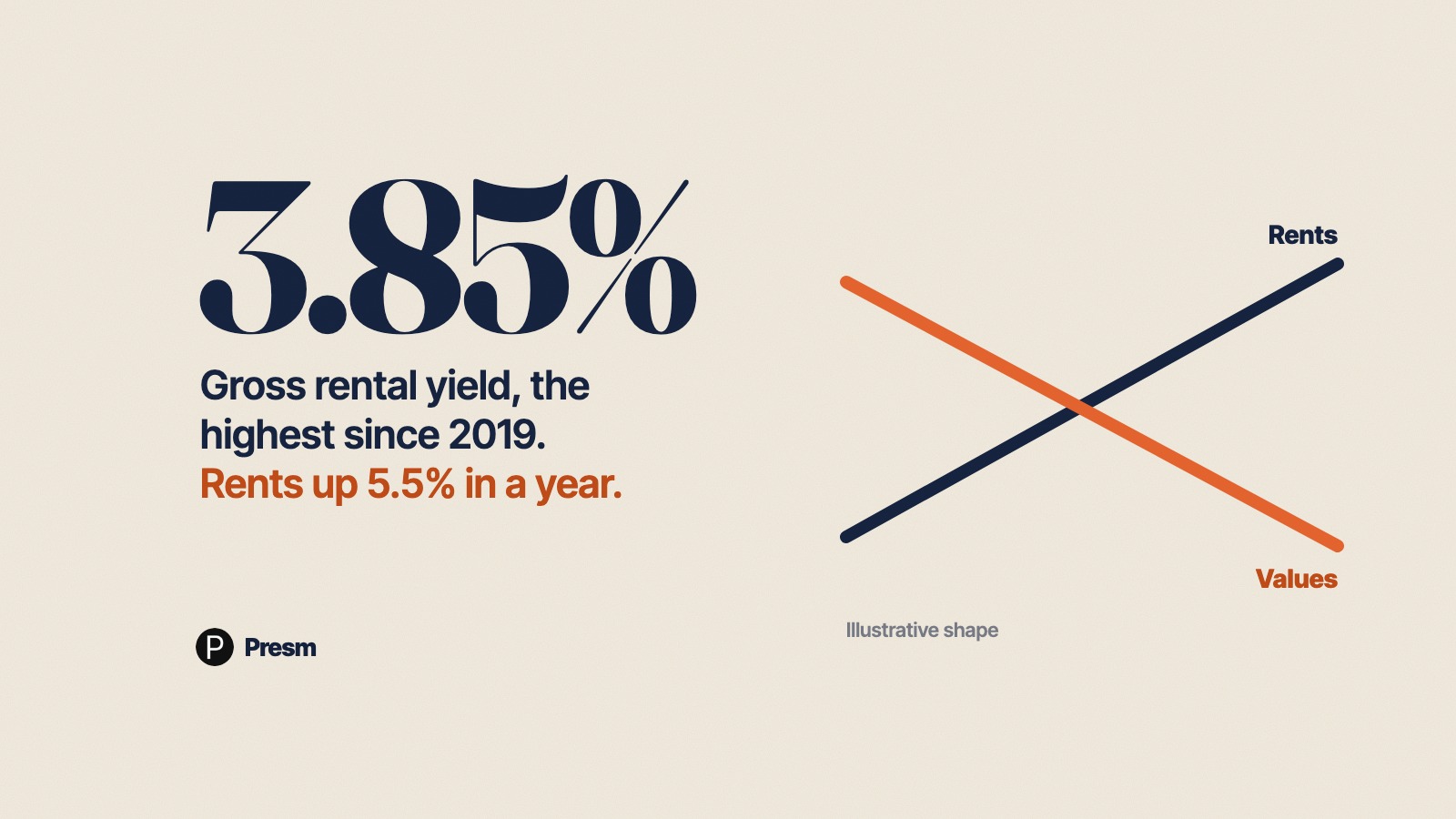
Indirectly. Lower rates increase property prices, which compresses gross yield. Rents tend to rise more slowly than prices in a cutting cycle, so net yields fall in the short run. Investors focused on yield should track the spread between gross yield and the new product rate, not the headline yield alone.
Presm
Property investment insights from the Presm research team.
Want to put these insights into action?
Presm gives you the tools to model, track, and grow your property portfolio with confidence.