Capital Gains Tax on Investment Property: How to Cut a $148,500 Bill to $74,250
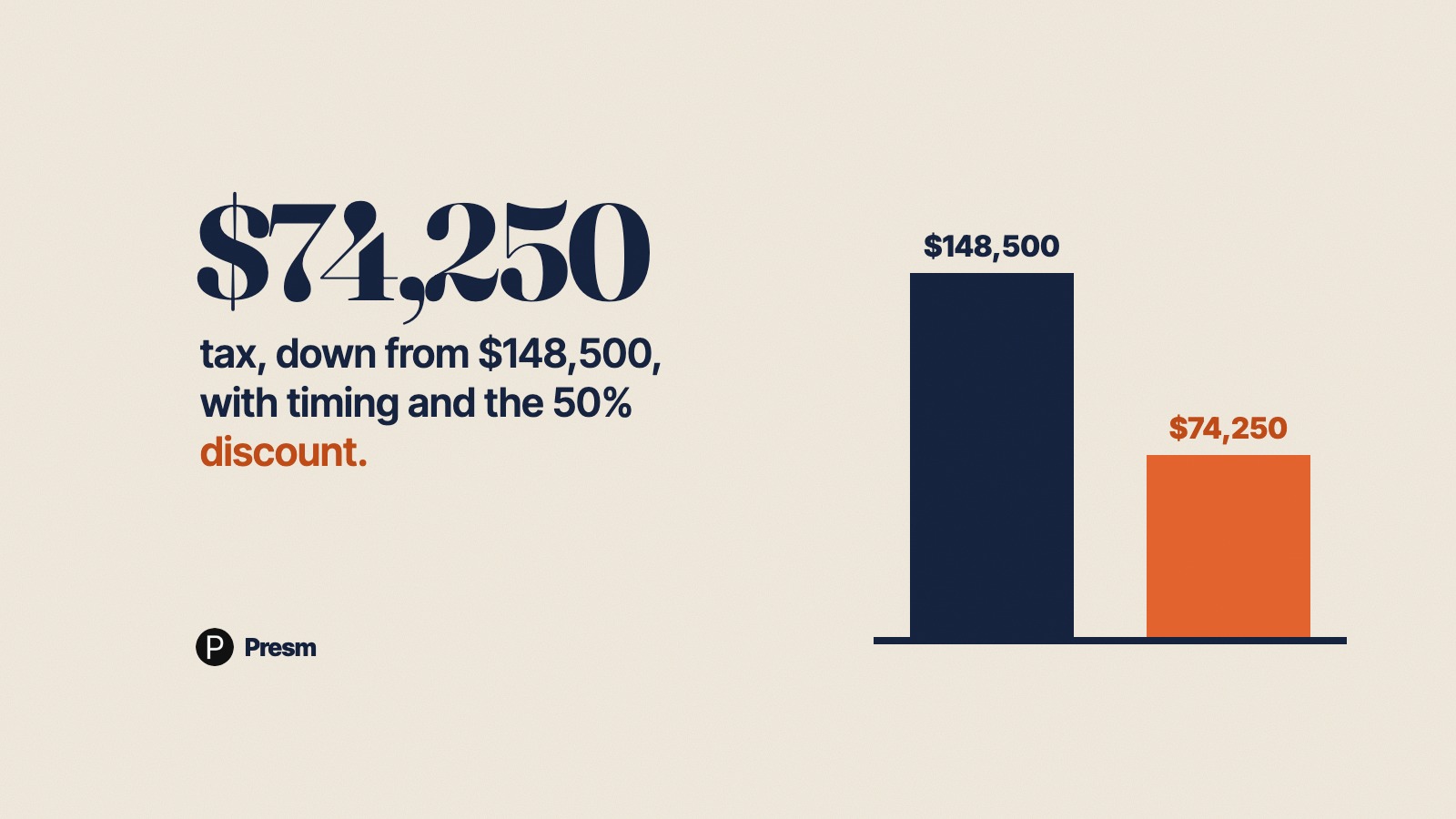
A Brisbane investor sells a Bulimba (4171) house for $1,200,000 after seven years of ownership. The purchase price was $640,000. On the surface, that is a $560,000 gain. The actual assessable gain after the rules apply is closer to $385,000, and the tax payable can be cut in half again with the 50% CGT discount.
The difference between an investor who knows the cost base rules and one who does not is roughly $74,000 on this single sale. Capital gains tax is the largest single tax event in most property investors' lifetimes, and almost every dollar of optimisation has to be set up before the contract is signed, not after.
This post walks the full maths on a real disposal, the five elements of cost base that most investors miss, the timing levers that move the bill by tens of thousands, and the structural mistakes that turn a manageable tax into a six-figure problem.
How CGT Actually Works in Australian Tax Law
Capital gains on investment property are calculated under Part 3-1 of ITAA 1997. The headline formula is straightforward:
Capital gain = Capital proceeds − Cost base
What changes the answer is what you can include in cost base, and whether the 50% discount applies under section 115-25 ITAA 1997.
The 50% discount that drives every Australian property investor's exit
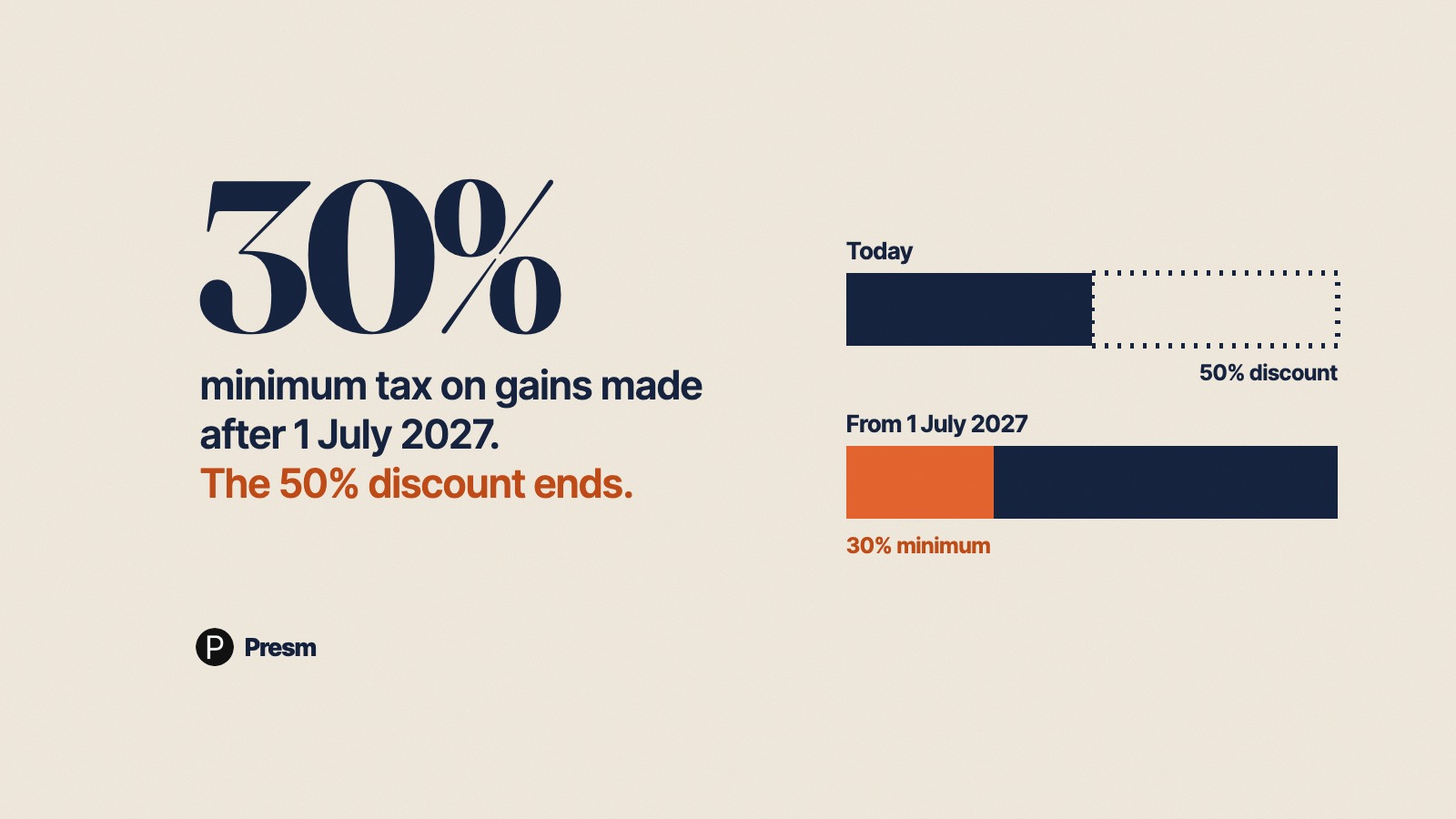
If the property was acquired by an individual or a trust and held for more than 12 months, the discount under Division 115 cuts the assessable gain by 50%. That is the single most valuable feature of the Australian tax system for property investors.
Companies do not get the discount — only individuals, trusts, and complying super funds (super funds get a 33.3% discount). This is one of the structural reasons most investors hold investment property in personal name or in a trust with individual beneficiaries, not in a corporate structure.
When CGT is triggered (it is not what most people think)
CGT is triggered on the contract date, not the settlement date. If you sign a contract on 28 June 2026 and settle on 15 August 2026, the gain is assessable in the FY 2025-26 return.
This is set out in section 104-10 of ITAA 1997. The CGT event A1 happens at contract.
This timing rule is also the basis for one of the most powerful CGT planning levers — covered later in this post.
The Five Elements of Cost Base That Most Investors Miss
Section 110-25 sets out the cost base of a CGT asset. There are five elements. Most investors include the first two and forget the rest.
Element 1: Money paid to acquire the asset
The purchase price. Straightforward. If you paid $640,000 for the property, that is element 1.
Element 2: Incidental costs of acquisition
These are costs incurred to acquire the asset:
- Stamp duty
- Legal fees on the purchase contract
- Conveyancing fees
- Title search and lodgement fees
- Mortgage establishment fees on the original loan
- Building inspections
- Pest inspections
- Buyer's agent fees
- Valuation fees paid by the buyer
For a $640,000 QLD purchase, element 2 typically totals $25,000-$30,000. This is the easy bucket — most accountants get this right.
Element 3: Costs of owning the asset
This is the bucket most investors miss. Section 110-25(4) covers costs of owning the asset that have not been claimed as a deduction during the holding period.
For a property that was rented the entire holding period, this element is generally zero — because the costs were already deducted against rental income. But for a property that was vacant land, sat unrented for periods, or had partial personal use, this can be substantial:
- Loan interest during periods of vacancy (where deduction was denied)
- Council rates during personal-use periods
- Insurance during personal-use periods
- Body corporate fees during personal-use periods
- Land tax during personal-use periods
If the property sat vacant for 18 months while the investor decided whether to sell or rent it, the holding costs during that period can usually be added to the cost base. This rule is at section 110-25(4) ITAA 1997.
Element 4: Capital improvements
Renovations, extensions, new kitchens, new bathrooms, structural work. NOT repairs and maintenance — those are claimed against rental income under section 25-10.
The distinction is critical:
- Replacing a worn-out kitchen with a similar one = repair (deductible in year incurred)
- Replacing a 1970s kitchen with a new modern kitchen = capital improvement (added to cost base)
- Painting an existing wall the same colour = repair
- Adding a new room or extension = capital improvement
A $42,000 kitchen renovation in 2021 that adds genuine value to the property goes into element 4. A $4,000 paint touch-up does not.
Element 5: Costs of preserving or defending title
Legal fees on a boundary dispute, Land Court proceedings, Lifestyle Estate disputes, similar.
Rare for typical residential property, but where it applies, the costs go to cost base.
The depreciation reduction (section 110-45)
After computing the five elements, you subtract any Division 43 capital works depreciation claimed during the hold period. Section 110-45 ITAA 1997 specifically reduces cost base by the cumulative Division 43 deductions.
Division 40 plant and equipment is treated separately as a balancing adjustment in the year of disposal — not a cost base reduction.
Worked Example: Bulimba Sale, Full Cost Base
The Bulimba investor's full cost base on the $640,000 purchase, after seven years of ownership and one major renovation:
| Cost base element | Amount |
|---|---|
| Element 1: Purchase price | $640,000 |
| Element 2: QLD stamp duty (2018 rates on $640,000) | $14,275 |
| Element 2: Legal and inspections | $2,400 |
| Element 2: Loan establishment fees (capitalised, then deducted over 5 years — net $0 to cost base because deducted) | $0 |
| Element 2: Buyer's agent fee | $11,500 |
| Element 4: Kitchen and bathroom renovation (2021) | $42,000 |
| Less: Division 43 depreciation claimed over 7 years ($8,000 × 7) | -$56,000 |
| Adjusted cost base | $654,175 |
Sale proceeds, net of agent commission and legal:
| Sale proceeds element | Amount |
|---|---|
| Contract price | $1,200,000 |
| Selling agent commission (2.5% incl. GST) | -$30,000 |
| Conveyancing | -$1,800 |
| Net capital proceeds | $1,168,200 |
Capital gain calculation:
| Step | Amount |
|---|---|
| Net proceeds | $1,168,200 |
| Adjusted cost base | $654,175 |
| Gross capital gain | $514,025 |
| Less: 50% CGT discount | -$257,013 |
| Assessable capital gain | $257,012 |
This $257,012 is added to the investor's taxable income in the year the contract was signed.
Tax Payable at FY 2025-26 Stage 3 Rates
If the investor's other taxable income (salary, etc.) is $145,000, the addition of $257,012 takes them across multiple brackets:
| Income band | Gain falling in band | Marginal rate (incl. Medicare) | Tax on this band |
|---|---|---|---|
| $145,001 to $190,000 | $45,000 | 39% | $17,550 |
| $190,001 to $402,012 | $212,012 | 47% | $99,646 |
| Total CGT payable | $117,196 |
- $145,001 to $190,000
- $45,000
- $190,001 to $402,012
- $212,012
- Total CGT payable
- —
- $145,001 to $190,000
- 39%
- $190,001 to $402,012
- 47%
- Total CGT payable
- —
- $145,001 to $190,000
- $17,550
- $190,001 to $402,012
- $99,646
- Total CGT payable
- $117,196
If the investor had not claimed the 50% discount (e.g., held in a company), the tax payable on the full $514,025 would have been around $241,500. The discount alone is worth $124,304 on this transaction.
If the investor had bought without records of the kitchen renovation and the buyer's agent fee — totalling $53,500 of cost base — the gain would have been $307,512 instead of $257,012. Tax on the additional $50,000 at the 47% top band: $23,500 of additional tax for missing receipts.
Five Levers That Move the CGT Number
Lever 1: Hold for 12 months minimum (do not miss this)
The 50% discount only applies after 12 months of ownership, measured from contract date to contract date. Selling at month 11 doubles the tax bill on the entire gain.
A property bought 15 March 2025 cannot be sold before 16 March 2026 without forfeiting the discount. Mark this date in your calendar from day one.
Lever 2: Time the contract date
CGT is triggered on the contract date, not settlement. If you sign in June 2026, the gain hits your 2025-26 return. If you sign in July 2026, it hits your 2026-27 return.
This means an investor with a high-income year ending 30 June can defer the gain into a lower-income year by delaying the contract by even a few days. Conversely, an investor with a tax-loss year (business losses, redundancy paid in following year) might pull the contract forward.
A worked example: an investor with $250,000 normal income but expects a $80,000 redundancy payout in FY 2026-27. Selling in June 2026 hits at the 47% top bracket on most of the gain. Selling in July 2026 stacks on top of $330,000 of income — every dollar of the gain hits 47%.
But if they hold until FY 2027-28, when income is back to $200,000 normal, much of the gain falls into the 39%/45% bands. The deferral by one year saves roughly $35,000 of tax on a $300,000 gain.
Lever 3: Pair the sale with a low-income year
A $257,000 gain hits much harder for an investor on $200,000 PAYG than for the same investor in a year where they have stepped down to $80,000 income. Retirees often time disposals to fall after they stop work.
The same gain at $80,000 starting income:
| Income band | Gain falling in band | Marginal rate | Tax |
|---|---|---|---|
| $80,001 to $135,000 | $55,000 | 32% | $17,600 |
| $135,001 to $190,000 | $55,000 | 39% | $21,450 |
| $190,001 to $337,012 | $147,012 | 47% | $69,096 |
| Total CGT | $108,146 |
- $80,001 to $135,000
- $55,000
- $135,001 to $190,000
- $55,000
- $190,001 to $337,012
- $147,012
- Total CGT
- —
- $80,001 to $135,000
- 32%
- $135,001 to $190,000
- 39%
- $190,001 to $337,012
- 47%
- Total CGT
- —
- $80,001 to $135,000
- $17,600
- $135,001 to $190,000
- $21,450
- $190,001 to $337,012
- $69,096
- Total CGT
- $108,146
That's $9,050 less than the same gain stacked on $145,000 of starting income.
Lever 4: Get a depreciation schedule from day one
The depreciation reduces cost base on sale, but the in-life deductions are usually worth more in present-value terms — you get the money now instead of when you sell. The investors who skip the QS report lose both: no annual deduction, AND they cannot reconstruct the cost base properly when they sell because they have no records of the original construction cost.
A $660 QS report typically returns $7,500-$11,000 of annual deductions over 25-30 years. The cost base reduction at sale partially offsets this, but the time value of money makes the present-value calculation strongly in favour of taking the deductions early.
Lever 5: Don't sell from a company structure
Companies do not access the 50% discount. The same $514,025 gain inside a company is taxed at 30% with no discount — that is $154,207 of tax versus $117,196 in personal name. If the property is in a company, you have lost the lever before you started.
This is why sophisticated investors hold investment property in:
- Personal name (full discount, simple)
- Discretionary trust with individual beneficiaries (discount preserved, asset protection added)
- Fixed unit trust with individual unitholders (discount preserved, more flexible income distribution)
NOT in:
- A company (loses discount, worst-of-both-worlds)
- A trust where the corporate beneficiary takes the gain (loses discount via the corporate beneficiary)
Where This Goes Wrong
Failure mode 1: No records of capital improvements
An investor who renovated their bathroom in 2019 but cannot produce invoices is going to have that $24,000 capital improvement disallowed by the ATO on audit. Keep every receipt, invoice, and bank statement for the entire hold period.
The ATO recommends keeping CGT records for at least 5 years after the asset is sold — but practically, you need to hold them from day one because you cannot reconstruct them later.
Failure mode 2: Confusing capital improvements with repairs
Replacing a 25-year-old kitchen is a capital improvement. Replacing a leaking dishwasher with a similar model is a repair. The first goes into cost base; the second is a deduction in the year of expenditure.
Mixing them up in either direction creates problems. Claiming a repair as a capital improvement loses the in-year deduction. Claiming a capital improvement as a repair triggers ATO adjustment with shortfall interest if discovered.
Failure mode 3: Selling in the same year as a redundancy payout
A $200,000 redundancy plus a $260,000 gain plus normal salary lights up the 47% bracket for a huge chunk of the gain. Time these events separately if you can.
A redundancy is generally taxed as an employment termination payment (ETP), with concessional treatment up to a cap. The genuine redundancy payment portion is tax-exempt up to a base amount plus a per-year-of-service amount. The non-concessional portion stacks with other income and pushes through the brackets.
Stacking a CGT event in the same year as an ETP is the worst possible timing.
Failure mode 4: Forgetting the main residence exemption only applies if you actually lived there
Renting a property out for seven years and then moving in for six months before selling does not get you full PPOR exemption. The exemption is apportioned on a time-and-use basis under Subdivision 118-B ITAA 1997.
The 6-year absence rule (section 118-145) lets you treat a property as your main residence for up to 6 years of absence, but only if no other property is nominated as your main residence during that period. This is a powerful planning tool but has narrow conditions.
Failure mode 5: Triggering CGT by transferring to a spouse or related party
Transferring property to a spouse, child, or related entity is a CGT event at market value, even if no money changes hands. There are limited rollovers under family law on relationship breakdown, but ordinary inter-spouse transfers crystallise the gain.
A husband transferring an investment property to his wife for "$1" still pays CGT on the market value gain. The "$1" does not reduce the deemed proceeds.
How To Plan Your Eventual Exit
Run scenarios in the Investment Optimiser before you list. The decision is rarely "sell or hold" — it is "sell now, sell next year, sell in retirement, refinance instead". Each option produces a different number.
Pair that with the Loan Repayment Calculator to model what happens if you refinance and pull equity instead of selling. Refinanced equity is not a CGT event. The interest on the refinanced portion is only deductible if the funds are used for income-producing purposes — but if you are using equity to fund another purchase, that test is met.
For broader entity-level decisions on which structure to hold the next property in, see our guide on SMSF property investment rules and risks and scaling property portfolios.
Frequently Asked Questions
When is CGT triggered — at contract or settlement?
At the contract date. The capital gain is assessable in the financial year the contract is signed, even if settlement occurs in the following year. This is set out in section 104-10 of ITAA 1997. If you sign on 30 June 2026, the gain is in your FY 2025-26 return regardless of when the property settles.
How long do I have to hold the property to get the 50% CGT discount?
At least 12 months from the contract date of acquisition to the contract date of disposal. Selling at 11 months and 30 days disqualifies the gain from the discount entirely. Section 115-25 ITAA 1997 sets out this requirement strictly.
Can I avoid CGT by transferring the property to my spouse?
Generally no. A transfer to a spouse is a CGT event at market value, even if no money changes hands. There are limited rollovers under family law on relationship breakdown (Subdivision 126-A ITAA 1997), but ordinary transfers between spouses crystallise the gain. The spouse who receives the property takes a new cost base equal to market value at transfer.
Does CGT apply if I move into the property after renting it?
Partial exemption applies. The gain is apportioned between the rented period (assessable, with 50% discount) and the PPOR period (exempt). The "six-year rule" in section 118-145 allows up to six years of absence to be treated as PPOR if no other home is nominated, but this is a planning tool with narrow conditions.
Is the 50% discount available if I hold the property in a trust?
Yes, if it is a trust where individual beneficiaries are presently entitled to the gain. The trust calculates the gain, the beneficiary picks up their share, and the beneficiary applies the 50% discount in their personal return. Companies inside trust structures break the chain — gains distributed to a corporate beneficiary do not retain the discount.
Presm
Property investment insights from the Presm research team.
Want to put these insights into action?
Presm gives you the tools to model, track, and grow your property portfolio with confidence.