Rental Yield: How a 5.4% Gross Becomes 2.1% Net (and Why That Matters)
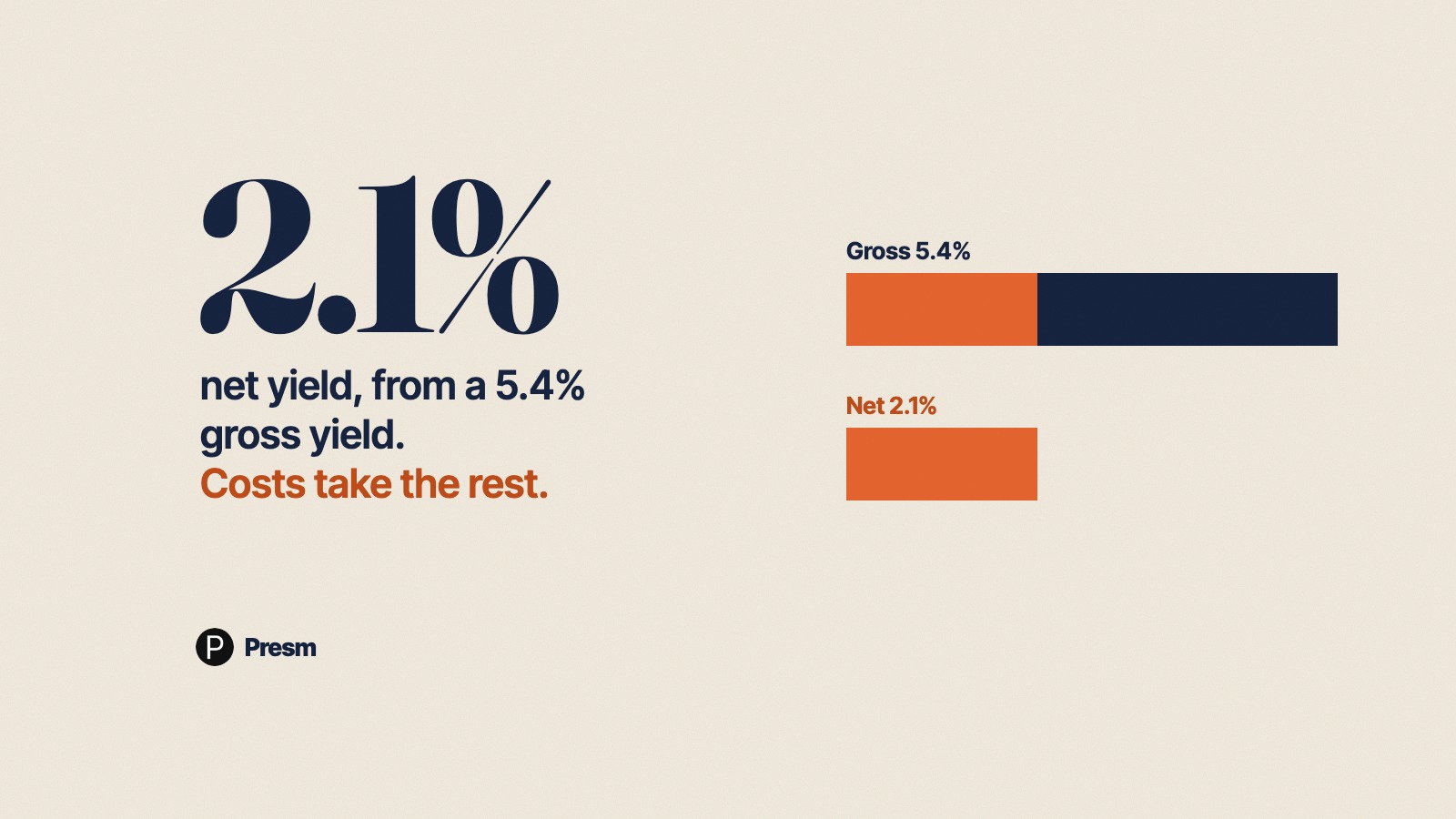
"This property has a 5.4% rental yield" sounds great until you realise that number is the gross yield — rent divided by purchase price, before any expense or interest. The net yield after holding costs is typically 1-3 percentage points lower, and the cash-on-cash return after the bank takes its share is often negative for the first 5-7 years.
Investors who buy on gross yield alone are buying on the marketing number, not the actual return. This post walks the four yield definitions, the maths on a real property, and which yield number matters for which decision.
The Four Yield Definitions
Definition 1: Gross yield. Annual rent divided by purchase price. The marketing number.
Definition 2: Net yield. Annual rent less all holding expenses (council rates, insurance, management, repairs, body corporate) divided by purchase price. Excludes loan interest.
Definition 3: Cash-on-cash return. Annual cash flow after all expenses including loan interest, divided by the cash deployed (deposit plus acquisition costs).
Definition 4: Total return. Cash flow plus capital growth, divided by cash deployed.
Each number answers a different question. Confusing them is how investors end up with a "5% yield" property that loses cash for a decade.
Worked Example: $750,000 Brisbane House
A Bulimba (4171) house. Purchase price $750,000. Rent $620/week. 80% LVR loan ($600,000 IO at 6.20%).
Gross yield calculation
Annual rent: $620 × 52 = $32,240 Gross yield: $32,240 / $750,000 = 4.30%
Net yield calculation
| Line | Amount |
|---|---|
| Property management 7.7% | $2,343 |
| Letting fee (annualised) | $400 |
| Vacancy allowance | $1,860 |
| Council rates | $2,400 |
| Water access | $1,200 |
| Insurance | $1,650 |
| Repairs | $1,800 |
| Total expenses | $11,653 |
Net rent: $32,240 − $11,653 = $20,587 Net yield: $20,587 / $750,000 = 2.74%
Cash-on-cash calculation
Cash deployed at acquisition: $173,245 Annual cash flow after loan interest: -$16,613 Cash-on-cash return: -9.59%
The same property has a 4.30% gross yield, a 2.74% net yield, and a -9.59% cash-on-cash return. All three numbers are correct.
Total return (after capital growth)
Assume 5% per annum capital growth. Year-one capital growth: $750,000 × 5% = $37,500 Total return: ($37,500 + (-$16,613)) / $173,245 = +12.06%
The property is producing a 12% total return on cash deployed, even though the cash flow itself is negative.
Which Yield Number Matters When
| Use case | Right yield to use |
|---|---|
| Comparing properties at listing stage | Gross yield |
| Filtering yield-driven vs growth-driven markets | Gross yield |
| Comparing properties on equal expense basis | Net yield |
| Assessing how hard your equity is working | Cash-on-cash |
| Measuring portfolio performance retrospectively | Total return |
Yield Across Markets and Property Types
Approximate gross yields by market and property type, early 2026:
| Market | Houses | Units |
|---|---|---|
| Sydney inner | 2.5-3.0% | 4.0-4.5% |
| Sydney middle | 3.0-3.5% | 4.5-5.0% |
| Sydney outer | 3.5-4.0% | 5.0-5.5% |
| Melbourne inner | 2.8-3.2% | 4.5-5.5% |
| Brisbane inner | 3.5-4.0% | 5.0-5.5% |
| Brisbane middle | 4.0-4.5% | 5.5-6.0% |
| Perth metro | 4.2% | 5.6% |
| Adelaide metro | 3.9% | 5.0% |
| Regional QLD/NSW | 5.5-6.5% | 6.0-7.0% |
- Sydney inner
- 2.5-3.0%
- Sydney middle
- 3.0-3.5%
- Sydney outer
- 3.5-4.0%
- Melbourne inner
- 2.8-3.2%
- Brisbane inner
- 3.5-4.0%
- Brisbane middle
- 4.0-4.5%
- Perth metro
- 4.2%
- Adelaide metro
- 3.9%
- Sydney inner
- 4.0-4.5%
- Sydney middle
- 4.5-5.0%
- Sydney outer
- 5.0-5.5%
- Melbourne inner
- 4.5-5.5%
- Brisbane inner
- 5.0-5.5%
- Brisbane middle
- 5.5-6.0%
- Perth metro
- 5.6%
- Adelaide metro
- 5.0%
The Yield-Growth Tradeoff
Higher yield typically means lower expected capital growth. The market prices yield and growth roughly inversely:
- A property with 6.5% gross yield in Tamworth (2340) typically grows 2-3% per annum
- A property with 3.5% gross yield in inner Brisbane typically grows 5-7% per annum
Total returns end up similar across the cycle, with growth-focused investors taking more cash flow drag in exchange for larger capital appreciation, and yield-focused investors taking less drag for less appreciation.
Where Yield Calculations Mislead
Mistake 1: Calculating yield on listed rent rather than achievable rent. Some agents quote rent that has not been achieved or is well above market. Verify with rental data sources.
Mistake 2: Ignoring body corporate fees on units. A unit with $5,000 of annual body corporate plus a sinking fund levy can have its net yield reduced by 1.0-1.5 percentage points compared to a comparable house.
Mistake 3: Forgetting non-cash deductions. Depreciation reduces the tax burden on rental income but does not improve the actual cash flow. Ignoring depreciation overstates cash-on-cash; including depreciation in the cash calculation overstates cash flow.
Mistake 4: Using current rent on properties with embedded under-rent. A property where the existing tenant pays $480/week against a $580/week market rent has a current yield that understates achievable yield.
How To Run The Numbers Quickly
For any candidate property, calculate:
- Gross yield (rent / price)
- Net yield (rent less expenses / price) — use 25-30% of gross rent as the expense estimate for a quick check
- Cash-on-cash including loan interest
Use the Loan Repayment Calculator to model the interest cost at different LVRs. The Borrowing Power Calculator helps confirm what loan size your income supports.
For the broader investment decision incorporating yield alongside growth, see our property investment strategy 2026 guide. For investor cash flow planning, see our first investment property guide.
Frequently Asked Questions
What is a "good" rental yield?
Depends on the market and your strategy. Inner Sydney houses at 3% gross yield can be excellent investments because of capital growth. Regional houses at 6% gross yield can be poor investments if there is no growth. The number alone is meaningless without context.
Should I aim for positive cash flow from year one?
Only if the strategy explicitly calls for it. Most metro buy-and-hold investments are negative cash flow for 3-7 years before flipping positive. Forcing positive cash flow from year one usually means buying lower-quality assets that compromise capital growth.
How much should I budget for expenses?
A rough rule is 25-30% of gross rent for typical residential houses (lower for new builds with low maintenance, higher for old houses with body corporate or strata). Get specific numbers from the rates notice, body corporate AGM minutes, and recent maintenance history.
Does property management cost more than self-management?
Typically 7-10% of weekly rent for property management. Self-management saves the fee but requires significant time investment and exposes you to tenant management directly. For most investors at scale (3+ properties or interstate holdings), professional management is the practical choice.
How do gross yields differ between houses and units?
Units generally have higher gross yields than houses (often 1-2 percentage points higher) because their prices include less land value. Net yields after body corporate fees are closer between the two property types. Cash-on-cash and total returns over 10+ years usually favour houses because of stronger capital growth.
Presm
Property investment insights from the Presm research team.
Want to put these insights into action?
Presm gives you the tools to model, track, and grow your property portfolio with confidence.