Tax Depreciation on Investment Property: The $11,200 Deduction Most Investors Underclaim
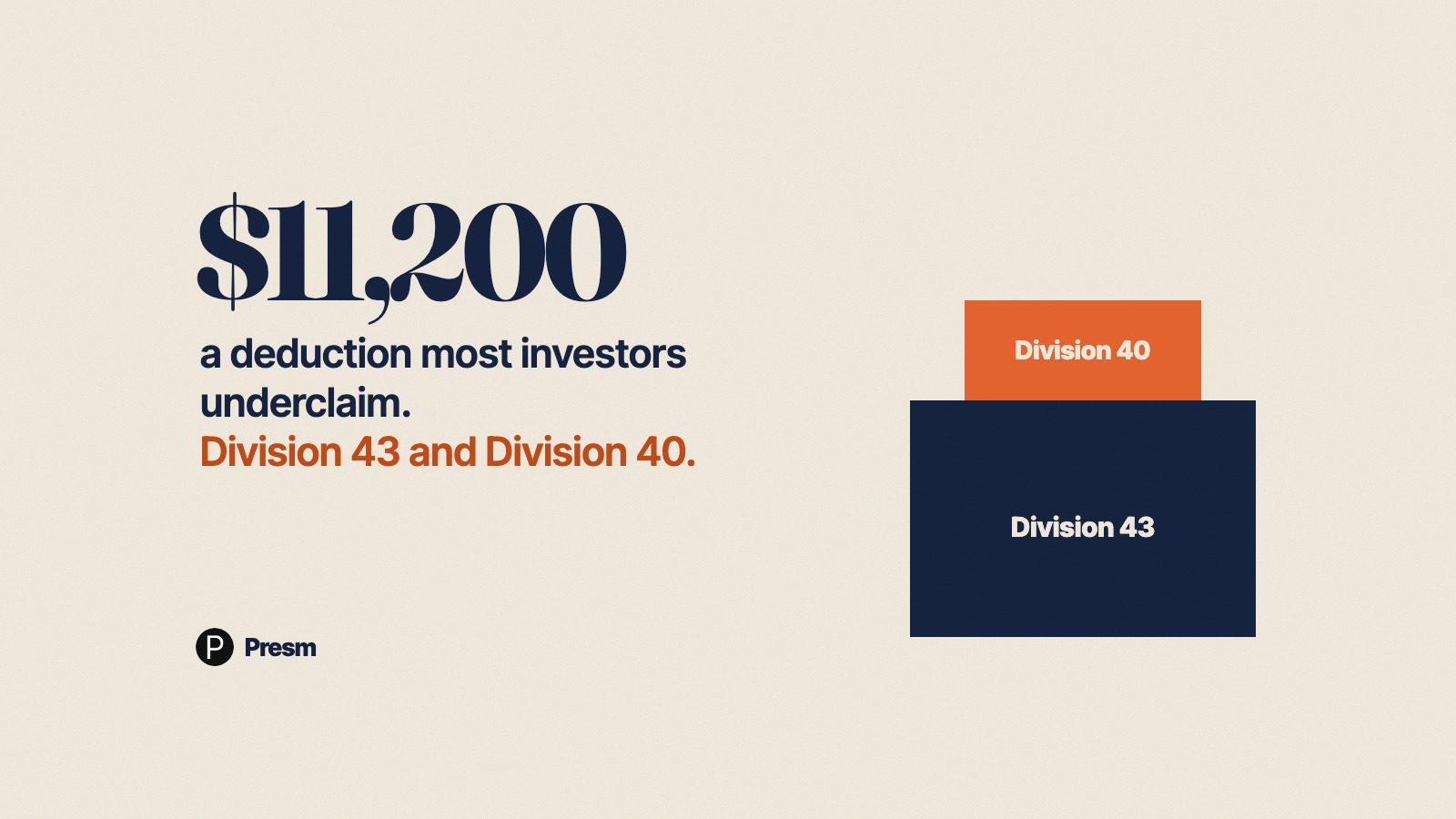
A $750,000 Brisbane house built in 2018 generates roughly $11,335 of depreciation in year one — non-cash deductions that translate to about $3,627 of tax saved at a 32% marginal rate. The investors who miss this number are not doing anything sophisticated wrong. They are simply skipping the $660 quantity surveyor report and assuming their accountant can estimate construction cost from a Google search.
The accountant cannot. The ATO does not accept estimates. And without the QS schedule, the deduction quietly evaporates, costing the investor $90,000+ of cumulative tax savings over a 25-year hold.
This post breaks down what depreciation actually is in Australian tax law, the two divisions that matter, the 2017 rule that broke the depreciation playbook for second-hand property, and the worked numbers on a real property.
What Depreciation Is
Depreciation is the recognition that an asset wears out and loses value over time. The Income Tax Assessment Act allows investors to claim that loss of value as an annual deduction against assessable income, even though no cash leaves their pocket.
For property, depreciation falls under two divisions:
Division 43 — Capital Works. The building itself, including extensions, alterations, and structural improvements. Claimed at 2.5% of construction cost per year, over 40 years, for residential buildings constructed after 15 September 1987.
Division 40 — Plant and Equipment. The removable items inside the building — ovens, dishwashers, hot water systems, carpets, blinds, air conditioners. Claimed using the diminishing value or prime cost method, over each item's effective life as set in TR 2025/X.
Both divisions reduce taxable income in the year they are claimed. Division 43 also reduces the cost base of the property on eventual sale (under section 110-45 ITAA 1997) — Division 40 does not.
The 2017 Rule That Broke Plant And Equipment
Section 40-27 of ITAA 1997, introduced 9 May 2017, prevents individual investors and most trusts from claiming depreciation on second-hand plant and equipment in a property they did not directly install.
In plain terms: if you buy a 2010-built house in 2024, you cannot claim Division 40 depreciation on the existing oven, hot water service, carpets, blinds, dishwasher, or air conditioner. They came with the property. You did not install them. They are second-hand. The deduction is denied.
You can claim Division 40 on items you install yourself after settlement. So the new dishwasher you put in three months after purchase generates depreciation. The existing oven does not.
This is the single biggest reason established-property depreciation schedules look thin compared to brand-new builds. New properties — the buyer is the first user of every plant and equipment item — get the full Division 40 claim.
The rule does NOT affect Division 43. Capital works deductions are still available on the building itself, regardless of who originally constructed it, provided it was built after 1987.
Worked Example: 2018 Brisbane Build, Year One Schedule
A $750,000 Bulimba (4171) house built in 2018, bought as a resale in 2025.
Division 43 — Capital Works
Original construction cost (estimated by the QS): approximately $300,000 for the residential structure. At 2.5% per year for 40 years from completion in 2018:
- Annual Division 43 deduction: $300,000 × 2.5% = $7,500
- Years remaining (40 − 7 elapsed): 33 years
- Total deduction available over remaining life: $247,500
That is $7,500 of deductible non-cash expense, every year, for 33 more years.
Division 40 — Plant and Equipment (Owner-Installed Only)
Existing plant cannot be claimed (2017 rule). The investor installs the following in year one:
| Item | Cost | Effective life | Year 1 deduction (DV method) |
|---|---|---|---|
| New dishwasher | $1,400 | 10 years | $280 |
| New ducted air conditioner | $4,800 | 10 years | $960 |
| New ceiling fans (full house) | $800 | 8 years | $200 |
| New oven | $1,800 | 12 years | $300 |
| New hot water service (replaced) | $2,100 | 12 years | $350 |
| New range hood | $600 | 12 years | $100 |
| New floor coverings (one room) | $4,500 | 10 years | $900 |
| New light fittings | $700 | 5 years | $280 |
| New carpet (master bedroom) | $1,500 | 10 years | $300 |
| New blinds (full house) | $2,800 | 10 years | $560 |
| New smoke detectors (replacements) | $300 | 6 years | $100 |
| Total Division 40 year 1 | $21,300 | $4,330 |
- New dishwasher
- $1,400
- New ducted air conditioner
- $4,800
- New ceiling fans (full house)
- $800
- New oven
- $1,800
- New hot water service (replaced)
- $2,100
- New range hood
- $600
- New floor coverings (one room)
- $4,500
- New light fittings
- $700
- New carpet (master bedroom)
- $1,500
- New blinds (full house)
- $2,800
- New smoke detectors (replacements)
- $300
- Total Division 40 year 1
- $21,300
- New dishwasher
- 10 years
- New ducted air conditioner
- 10 years
- New ceiling fans (full house)
- 8 years
- New oven
- 12 years
- New hot water service (replaced)
- 12 years
- New range hood
- 12 years
- New floor coverings (one room)
- 10 years
- New light fittings
- 5 years
- New carpet (master bedroom)
- 10 years
- New blinds (full house)
- 10 years
- New smoke detectors (replacements)
- 6 years
- Total Division 40 year 1
- —
- New dishwasher
- $280
- New ducted air conditioner
- $960
- New ceiling fans (full house)
- $200
- New oven
- $300
- New hot water service (replaced)
- $350
- New range hood
- $100
- New floor coverings (one room)
- $900
- New light fittings
- $280
- New carpet (master bedroom)
- $300
- New blinds (full house)
- $560
- New smoke detectors (replacements)
- $100
- Total Division 40 year 1
- $4,330
The dishwasher deduction reduces in year two as the diminishing-value method bites. By year five, that $280 has fallen to $180. By year ten, the asset is fully written off.
Combined Year-One Depreciation
$7,500 (Div 43) + $3,835 (Div 40) = $11,335
(Note: figures rounded; actual schedule depends on exact installation dates.)
What This Is Worth In Tax
At a 32% blended marginal rate (income $145,000 plus Medicare):
- $11,335 of deductions × 32% = $3,627 in tax saved
Across the property's effective life:
- Division 43 alone: $7,500 × 33 years = $247,500 of deductions remaining → $79,200 of tax saved over 33 years at 32%
- Division 40 over typical 10-year cycle: roughly $25,000 of total deductions → $8,000 of tax saved
These are the numbers behind why a QS depreciation schedule (cost: $660-$800, deductible) pays for itself many times over in year one. The $660 fee returns roughly $3,627 of tax saved in year one alone, before any of the future-year deductions are even considered.
When The QS Report Cannot Help You
There are properties where the depreciation schedule will be small or zero:
Pre-1987 buildings
Division 43 only applies to construction after 15 September 1987. A 1972 Federation house in Newtown (2042) generates zero Division 43 deduction. You can still claim on capital improvements made after 1987 (a 1995 kitchen renovation, a 2005 extension), but the original structure is out.
If the property has had post-1987 capital improvements, the QS schedule is still worthwhile — those improvements may generate $2,000-$5,000 of annual deduction even if the original building is too old.
Bought after 9 May 2017 with no owner-installed plant
A 1990s house bought as-is, never touched, generates Division 43 on the building only — no Division 40. The schedule is half what a comparable new build would deliver.
Properties owned for less than 12 months
Depreciation is apportioned. A property bought 1 January claims six months of Division 43 in the first year ($3,750 instead of $7,500). The QS schedule will calculate this correctly but the year-one deduction will be smaller than a full-year claim.
Substantial renovations done by previous owner
Division 43 on improvements completed by a previous owner is still claimable. The QS report includes those — but only if records exist or the surveyor can inspect and date the work.
Where This Goes Wrong
Failure mode 1: Skipping the QS report on the assumption "my property is too old"
A 1990s build is not too old. Division 43 still applies (anything post-1987). Investors who skip the schedule because they assume nothing is claimable lose $4,000-$8,000 a year of legitimate deductions for the entire hold period.
Over a 20-year hold at $6,000 per year of Division 43, that's $120,000 of cumulative deductions missed. At a 32% marginal rate, that's $38,400 of tax saved that the investor never claimed.
Failure mode 2: Claiming depreciation on the existing oven and hot water service
The 2017 rule does not allow second-hand plant. Auditors flag this aggressively. Investors who fudge the schedule lose the deduction and pay shortfall interest plus potential penalties.
Failure mode 3: Forgetting that Division 43 reduces cost base on sale
Every dollar claimed under Division 43 reduces the cost base under section 110-45. A $200,000 lifetime Division 43 claim becomes a $200,000 increase in assessable capital gain when the property is sold. The deduction is not costless — it is a deferral with a sale-time correction.
But the present-value maths still strongly favours taking the deductions. $7,500 saved in tax now (at 32%, that's $2,400 of cash) is worth more than $7,500 of cost base reduction in 20 years (which adds $1,200 to CGT after the 50% discount, at 32% marginal rate).
The deferral typically nets out positive by a 2:1 ratio in present-value terms.
Failure mode 4: Disposing of plant and equipment without a balancing adjustment
When you replace a depreciating asset (the old air conditioner is removed and a new one installed), the old asset's adjustable value at the date of disposal can usually be claimed in full as a balancing-adjustment deduction. Investors who simply stop depreciating the old item miss this last-year claim.
Failure mode 5: Treating renovations as repairs
A new kitchen is a Division 43 capital improvement, not a section 25-10 repair. Claiming it as a repair gives you a one-year deduction; the ATO reverses it on review and applies the 40-year Division 43 spread instead — usually with shortfall interest.
How To Actually Capture This
Order a QS-prepared depreciation schedule within the first 90 days of settlement. Cost is $660-$800. The schedule covers the full life of the property and is updated only when you do major capital works.
Run the Loan Repayment Calculator to estimate your year-one interest, then add the depreciation number to model the full cash-and-tax position. The two numbers together drive the after-tax cost of holding.
For broader context on every deduction available on a rental property, see our complete rental property tax deductions checklist. For the impact of Division 43 on disposal, see our reduce capital gains tax guide.
Frequently Asked Questions
Does the QS need to inspect the property?
Yes, in most cases. ATO Tax Ruling TR 97/25 requires the QS to make reasonable estimates of construction cost, which usually includes a physical site inspection to identify capital works and plant items. A desktop schedule prepared without inspection is generally not accepted.
Can my accountant prepare the depreciation schedule?
Generally no, for Division 43 purposes. Accountants are not recognised as having the expertise to estimate construction costs under TR 97/25. They can apply the schedule once it is prepared, but the schedule itself needs to come from a quantity surveyor.
Is the QS fee tax deductible?
Yes. The fee for preparing the depreciation schedule is deductible under section 8-1 in the year you incur it. A $660 fee at a 32% marginal rate returns $211 in tax savings, on top of all the depreciation it unlocks.
How long does Division 43 last?
40 years from completion of the original construction or improvement. A house completed in 2010 has Division 43 deductions available until 2050 — assuming no demolition or destruction in between.
What happens to depreciation if I move into the property as my home?
Depreciation stops being claimable from the day the property ceases to produce assessable income. The Division 43 deductions claimed during the rental period still reduce the cost base when you eventually sell — even if you have lived in the property for years in between, partial CGT exemption rules apply on a use-and-time basis under Subdivision 118-B.
Presm
Property investment insights from the Presm research team.
Want to put these insights into action?
Presm gives you the tools to model, track, and grow your property portfolio with confidence.