Every Rental Property Tax Deduction in 2026: The 28-Item Checklist Worth $9,000 a Year
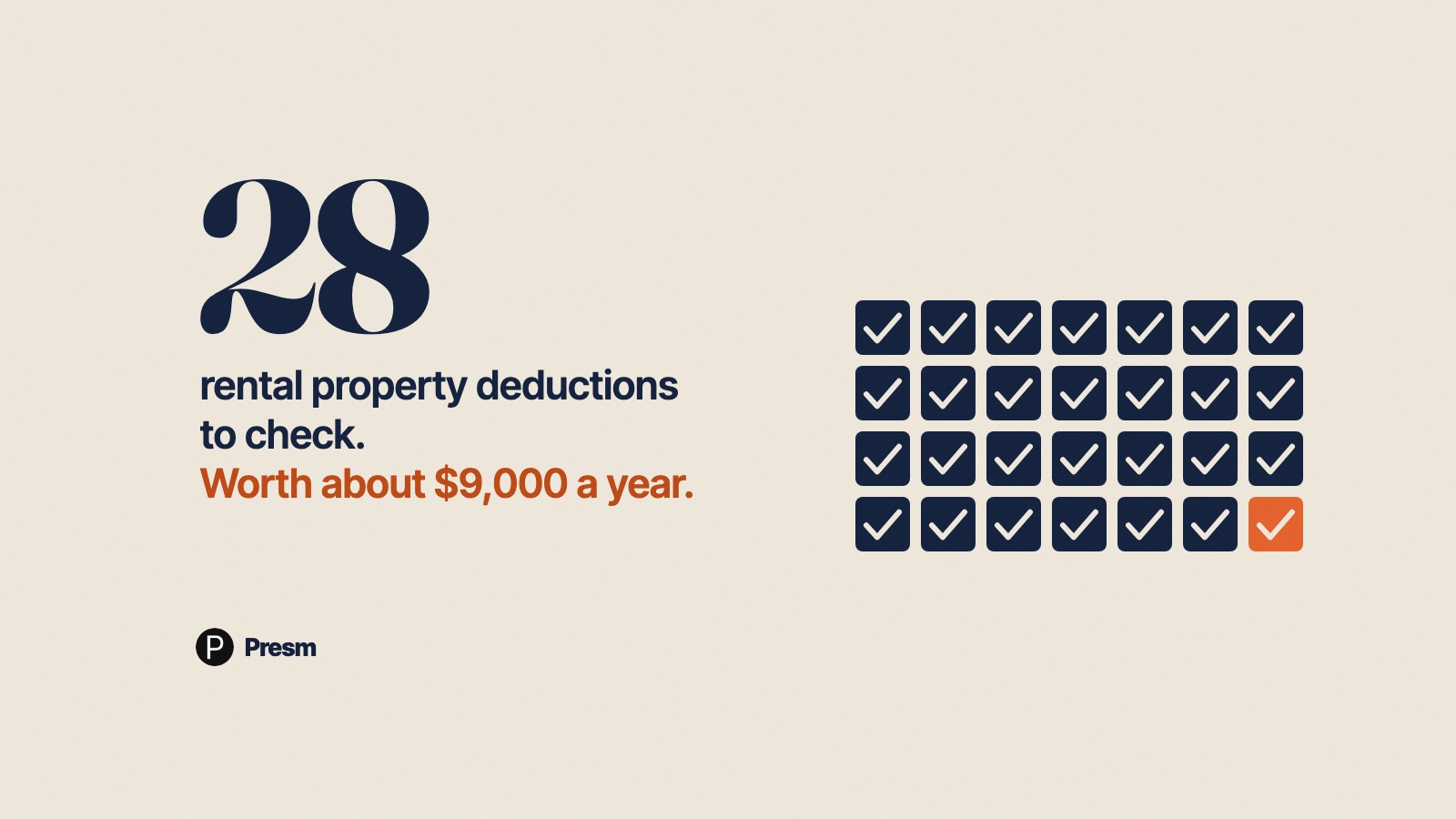
A typical Brisbane rental property generates $9,000 to $14,000 of legitimate annual deductions that do not appear on most accountants' default schedules. The ones that get missed are not exotic — they are borrowing costs spread under section 25-25, the Division 40 plant and equipment items the QS report did not pick up, and the depreciation on improvements made between purchase years.
The investors who get the full claim are not running tax avoidance schemes. They are running tidy records and checking the schedule against a real list. This post is that list, with the ATO section reference next to each item, and the worked numbers on a real $750,000 Bulimba property.
What "Deductible" Actually Means
A rental property expense is deductible to the extent it has a sufficient connection to producing assessable income, under section 8-1 of ITAA 1997. The two limbs of the test are simple — incurred in gaining or producing assessable income, or necessarily incurred in carrying on a business for that purpose. Capital outgoings are excluded from section 8-1 but most are picked up under specific provisions (depreciation, capital works, borrowing costs).
That distinction matters because the ATO's default position on a contested expense is to deny the deduction unless the connection is documented. Receipts are not optional.
The Complete 28-Item Deduction Checklist
Income-related expenses (claim 100% in year incurred)
| # | Item | ATO provision | Notes |
|---|---|---|---|
| 1 | Loan interest | s 8-1 | Only on the income-producing portion of the loan |
| 2 | Council rates | s 8-1 | Quarterly statements, full claim |
| 3 | Water rates and supply charges | s 8-1 | Tenant-paid water usage is not deductible to the owner |
| 4 | Land tax | s 8-1 | Per state, per assessment notice |
| 5 | Body corporate fees (admin fund) | s 8-1 | NOT the sinking fund — that is capital |
| 6 | Building insurance | s 8-1 | Including landlord insurance |
| 7 | Property management fees | s 8-1 | Including letting fees, leasing commissions |
| 8 | Advertising for tenants | s 8-1 | First rent ad and subsequent re-leases |
| 9 | Cleaning between tenancies | s 8-1 | End-of-lease cleans, professional services |
| 10 | Pest control | s 8-1 | Routine treatments, including rats and termite preventatives |
| 11 | Gardening and lawn maintenance | s 8-1 | Where landlord pays under lease |
| 12 | Quantity surveyor report (initial) | s 8-1 | The QS fee itself is deductible in year one |
| 13 | Travel to inspect (residential) | s 26-31 | DENIED for residential since 2017. Commercial only. |
- 1
- Loan interest
- 2
- Council rates
- 3
- Water rates and supply charges
- 4
- Land tax
- 5
- Body corporate fees (admin fund)
- 6
- Building insurance
- 7
- Property management fees
- 8
- Advertising for tenants
- 9
- Cleaning between tenancies
- 10
- Pest control
- 11
- Gardening and lawn maintenance
- 12
- Quantity surveyor report (initial)
- 13
- Travel to inspect (residential)
- 1
- s 8-1
- 2
- s 8-1
- 3
- s 8-1
- 4
- s 8-1
- 5
- s 8-1
- 6
- s 8-1
- 7
- s 8-1
- 8
- s 8-1
- 9
- s 8-1
- 10
- s 8-1
- 11
- s 8-1
- 12
- s 8-1
- 13
- s 26-31
- 1
- Only on the income-producing portion of the loan
- 2
- Quarterly statements, full claim
- 3
- Tenant-paid water usage is not deductible to the owner
- 4
- Per state, per assessment notice
- 5
- NOT the sinking fund — that is capital
- 6
- Including landlord insurance
- 7
- Including letting fees, leasing commissions
- 8
- First rent ad and subsequent re-leases
- 9
- End-of-lease cleans, professional services
- 10
- Routine treatments, including rats and termite preventatives
- 11
- Where landlord pays under lease
- 12
- The QS fee itself is deductible in year one
- 13
- DENIED for residential since 2017. Commercial only.
Repairs and maintenance (section 25-10, 100% if genuinely a repair)
| # | Item | ATO provision | Notes |
|---|---|---|---|
| 14 | Repainting (existing colours) | s 25-10 | Same scope counts as repair, not improvement |
| 15 | Replacing broken fixtures (like for like) | s 25-10 | Tap, hot water service of same type |
| 16 | Carpet patch repair | s 25-10 | Replacement of damaged carpet is repair if same quality |
| 17 | Plumbing call-outs | s 25-10 | Drain blockages, leak repairs |
| 18 | Roofing repairs | s 25-10 | Tile replacement, gutter clearing — repair only |
| 19 | Electrical fixes | s 25-10 | Switch replacement, fault rectification |
- 14
- Repainting (existing colours)
- 15
- Replacing broken fixtures (like for like)
- 16
- Carpet patch repair
- 17
- Plumbing call-outs
- 18
- Roofing repairs
- 19
- Electrical fixes
- 14
- s 25-10
- 15
- s 25-10
- 16
- s 25-10
- 17
- s 25-10
- 18
- s 25-10
- 19
- s 25-10
- 14
- Same scope counts as repair, not improvement
- 15
- Tap, hot water service of same type
- 16
- Replacement of damaged carpet is repair if same quality
- 17
- Drain blockages, leak repairs
- 18
- Tile replacement, gutter clearing — repair only
- 19
- Switch replacement, fault rectification
Capital works (Division 43, 2.5% per year over 40 years)
| # | Item | ATO provision | Notes |
|---|---|---|---|
| 20 | Original construction (post-1987) | Div 43 | Building cost claimed at 2.5% over 40 years |
| 21 | Capital improvements (kitchen, bathroom) | Div 43 | New asset, claimed over 40 years from completion |
| 22 | Structural alterations | Div 43 | Walls, additions, decks (load-bearing) |
| 23 | Driveways, fencing, paving | Div 43 | If part of original or capital improvement |
- 20
- Original construction (post-1987)
- 21
- Capital improvements (kitchen, bathroom)
- 22
- Structural alterations
- 23
- Driveways, fencing, paving
- 20
- Div 43
- 21
- Div 43
- 22
- Div 43
- 23
- Div 43
- 20
- Building cost claimed at 2.5% over 40 years
- 21
- New asset, claimed over 40 years from completion
- 22
- Walls, additions, decks (load-bearing)
- 23
- If part of original or capital improvement
Plant and equipment (Division 40, declining balance)
| # | Item | ATO provision | Notes |
|---|---|---|---|
| 24 | Hot water systems, ovens, dishwashers | Div 40 | Effective life table TR 2025/X |
| 25 | Carpets, blinds, curtains (new install only post-2017 acquisition) | Div 40 | Existing-asset rule limits second-hand claims |
| 26 | Air conditioning, ceiling fans | Div 40 | Per ATO effective life schedule |
- 24
- Hot water systems, ovens, dishwashers
- 25
- Carpets, blinds, curtains (new install only post-2017 acquisition)
- 26
- Air conditioning, ceiling fans
- 24
- Div 40
- 25
- Div 40
- 26
- Div 40
- 24
- Effective life table TR 2025/X
- 25
- Existing-asset rule limits second-hand claims
- 26
- Per ATO effective life schedule
Borrowing costs (section 25-25, spread over 5 years or loan term)
| # | Item | ATO provision | Notes |
|---|---|---|---|
| 27 | Loan establishment fees, LMI premium, valuation fees | s 25-25 | Spread over the lesser of 5 years or loan term |
| 28 | Mortgage broker fees (where invoiced separately to investor) | s 25-25 | Same spread |
- 27
- Loan establishment fees, LMI premium, valuation fees
- 28
- Mortgage broker fees (where invoiced separately to investor)
- 27
- s 25-25
- 28
- s 25-25
- 27
- Spread over the lesser of 5 years or loan term
- 28
- Same spread
The 2017 Travel Ban — Most Investors Still Get This Wrong
Section 26-31 of ITAA 1997, introduced in the 2017 budget, denies travel deductions for residential investment properties for individual investors and most trusts. You cannot claim flights, accommodation, fuel, or vehicle running costs to inspect, manage, or maintain a residential rental.
The exception is commercial property (offices, retail, industrial), and properties held by certain entity types — public unit trusts, super funds, complying APRA funds, and large widely-held entities.
Investors who still claim residential travel get adjusted on review. The denial includes flights to inspect, mileage to meet trades, and overnight accommodation while supervising work.
A worked example: an investor flies from Sydney to Brisbane four times per year to inspect a rental property. Each trip costs $500 in flights, $300 accommodation, $100 in transport. Total annual travel cost: $3,600.
Under the 2017 rule, none of this is deductible. The investor must absorb the $3,600 from after-tax income. At a 32% marginal rate, the lost deduction is worth $1,152/year.
The Plant and Equipment Rule That Halves Most Schedules
Also from 2017: section 40-27 prevents individual investors from claiming Division 40 depreciation on second-hand plant and equipment in a property they did not directly install. The rule applies to existing properties bought after 9 May 2017.
In practice this means that if you buy a 2010-built Brisbane house in 2024, you cannot claim depreciation on the existing oven, hot water service, carpet, blinds, and air conditioner that were already there. You can only claim Division 40 on items you install yourself after settlement.
This is why depreciation schedules on resale properties often look thin — most of the plant and equipment is locked out. Division 43 (the building itself) still applies, and that is usually the larger half of the schedule anyway.
New builds and substantial renovations escape this rule because the investor is the first user of the new plant. Hence the depreciation-driven push toward off-the-plan and brand-new property — though that comes with its own trade-offs covered in our off the plan vs established properties guide.
Worked Example: Bulimba House, Year One Deductions
A $750,000 Bulimba (4171) house bought 1 July 2025, rented at $620 per week, financed with a $600,000 IO loan at 6.20%.
| Deduction line | Amount | Provision |
|---|---|---|
| Loan interest ($600,000 × 6.20%) | $37,200 | s 8-1 |
| Property management 7.7% | $2,343 | s 8-1 |
| Council rates | $2,400 | s 8-1 |
| Water access | $1,200 | s 8-1 |
| Building insurance | $1,650 | s 8-1 |
| Repairs and maintenance | $1,800 | s 25-10 |
| Body corporate (admin) | $0 | n/a (house) |
| Borrowing costs (1/5 of $4,200) | $840 | s 25-25 |
| QS report | $660 | s 8-1 |
| Letting fee | $400 | s 8-1 |
| Vacancy allowance impact | included in management | s 8-1 |
| Division 43 capital works (post-1987 build) | $7,500 | Div 43 |
| Division 40 plant (only owner-installed dishwasher + AC) | $1,750 | Div 40 |
| Total deductions | $57,743 |
- Loan interest ($600,000 × 6.20%)
- $37,200
- Property management 7.7%
- $2,343
- Council rates
- $2,400
- Water access
- $1,200
- Building insurance
- $1,650
- Repairs and maintenance
- $1,800
- Body corporate (admin)
- $0
- Borrowing costs (1/5 of $4,200)
- $840
- QS report
- $660
- Letting fee
- $400
- Vacancy allowance impact
- included in management
- Division 43 capital works (post-1987 build)
- $7,500
- Division 40 plant (only owner-installed dishwasher + AC)
- $1,750
- Total deductions
- $57,743
- Loan interest ($600,000 × 6.20%)
- s 8-1
- Property management 7.7%
- s 8-1
- Council rates
- s 8-1
- Water access
- s 8-1
- Building insurance
- s 8-1
- Repairs and maintenance
- s 25-10
- Body corporate (admin)
- n/a (house)
- Borrowing costs (1/5 of $4,200)
- s 25-25
- QS report
- s 8-1
- Letting fee
- s 8-1
- Vacancy allowance impact
- s 8-1
- Division 43 capital works (post-1987 build)
- Div 43
- Division 40 plant (only owner-installed dishwasher + AC)
- Div 40
- Total deductions
- —
Rent for the year: $32,240 less vacancy $1,860 = $30,380.
Net rental loss: $30,380 - $57,743 = -$27,363
At a 32% blended marginal rate (income $145,000), the refund is roughly $9,400.
If the investor had skipped the QS report and the careful borrowing-cost claim, the deductions would have been roughly $48,000 — a $9,743 gap, worth about $3,118 in tax. That gap is the difference between an investor who runs the checklist and one who hands their accountant a stack of receipts and hopes.
Where This Goes Wrong
Failure mode 1: Claiming repairs that are actually improvements
Replacing a 25-year-old kitchen with a new one is a capital improvement (Division 43 over 40 years), not a repair. Investors who claim it as a repair get the full deduction reversed and pay shortfall interest on top.
A worked example: an investor claims a $32,000 kitchen renovation as a "repair" in year one. The ATO disallows the deduction, recategorises it as Division 43, and applies it at 2.5% per year ($800/year for 40 years). The year-one deduction drops from $32,000 to $800.
Tax impact at 32%: $32,000 × 32% = $10,240 of tax originally claimed. After ATO adjustment: $800 × 32% = $256.
The investor owes back $9,984 of tax, plus shortfall interest at the GIC rate (currently around 11%), plus potentially a 25% administrative penalty. Total cost: roughly $13,500-$15,000 on a single misclassification.
Failure mode 2: Not apportioning loan interest after refinance
If you refinance and pull cash for personal use, the interest on the cash-out portion is not deductible. The split has to be tracked from the date of refinance.
The cleanest way: separate loan accounts. Investment portion in one loan, cash-out portion in another. Without this segregation, the ATO can deny the entire interest deduction on the basis the investor cannot establish what proportion was for income-producing purposes.
Failure mode 3: Forgetting borrowing costs spread
Investors deduct the full LMI premium in year one. The ATO denies four-fifths of it. The borrowing costs spread under s 25-25 is not optional.
Items that must be spread:
- LMI premium
- Loan establishment fee
- Valuation fees paid by the bank but charged to you
- Mortgage registration and stamping costs
A $14,000 LMI premium claimed all in year one returns $4,480 of tax saving. Same premium spread correctly returns $896 per year for 5 years — same total tax saving, but timed differently.
Failure mode 4: Claiming Division 40 on second-hand items
The 2017 rule still trips up new entrants. Existing dishwashers, blinds, and air conditioners in a property you bought are not deductible.
A QS schedule on a 2024 purchase of a 2008-built property might show $4,500 of "deemed" plant and equipment. Section 40-27 makes most of this non-deductible to a residential investor. The schedule may include items that are technically there but legally cannot be claimed.
Failure mode 5: Vacant land between tenancies
If a property sits vacant longer than reasonable while you renovate or look for tenants, the ATO can deny deductions for the period it is genuinely held out of use. Document the active marketing for tenants if there is a gap.
The test is "available for income production" — listed for rent, marketed actively, ready for occupation. A property gutted for renovation is generally not available; a property advertised at market rent with no acceptable tenants is.
How To Actually Capture The Full Claim
Run a Loan Repayment Calculator at the start of every financial year to confirm your interest claim — it is the single largest deduction and the most often misstated, especially after rate changes mid-year. Run the Borrowing Power Calculator before refinancing to confirm the apportionment is clean.
Get a QS-prepared depreciation schedule on every property in the first year of ownership. The $660-$800 cost is deductible and the schedule pays for itself on the first year's depreciation alone.
For deeper coverage on getting depreciation right, see our tax depreciation on investment properties guide. For how these deductions interact with negative gearing strategy, see our negative gearing 2026 guide.
Frequently Asked Questions
Can I claim travel to my interstate rental property?
No, not for residential rentals. Section 26-31 of ITAA 1997 denies travel deductions for residential investment properties for individual investors. The denial applies to flights, accommodation, fuel, and motor vehicle expenses regardless of distance. Commercial property travel is still deductible.
Are renovations deductible in the year I do them?
Generally no. Renovations that are capital improvements are claimed under Division 43 at 2.5% per year over 40 years. Only genuine repairs to an existing item or surface are deductible in the year incurred under section 25-10. A new kitchen is capital; a leaking dishwasher replacement is repair.
Can I claim my accountant's fees for preparing my rental schedule?
Yes, accountants' fees relating to managing your tax affairs (including rental schedule preparation) are deductible under section 25-5 in the year incurred. This includes preparation of investment property tax returns, advice on rental issues, and ATO disputes related to investment properties.
Is loan interest still deductible during periods of vacancy?
Yes, provided the property is genuinely available for rent and being actively marketed. If you withdraw the property from the rental market — to renovate, to allow family use, or while deciding whether to sell — interest deductions are denied for that period. Document active marketing efforts to support the deduction.
Do I need a depreciation schedule from a quantity surveyor, or can my accountant prepare one?
The ATO accepts depreciation schedules prepared by qualified quantity surveyors, who are recognised under TR 97/25 as having the relevant expertise to estimate construction costs. Accountants generally cannot estimate construction costs for Division 43 purposes, which is why the QS report is the standard. Schedule cost ($660-$800) is deductible in year one.
Presm
Property investment insights from the Presm research team.
Want to put these insights into action?
Presm gives you the tools to model, track, and grow your property portfolio with confidence.